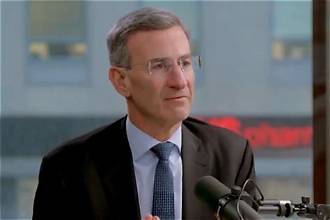

Peter Orszag’s hair has a recognizable shape: a defined side part, neatly combed length on top, and shorter sides. Photographs from his White House years show darker hair, while a September 2026 television appearance shows a much grayer version of that familiar style. The haircut is straightforward; the toupee story attached to it needs closer examination.
An original newspaper profile helps explain where that story came from. Read alongside official photographs, it offers a more useful account of Peter Orszag’s hairstyle than claims about cosmetic treatments based on appearance alone.
What Does Peter Orszag’s Hair Look Like?
Orszag’s official Lazard portrait shows a conventional business haircut with enough length on top to sweep across from a visible part. The sides sit close to the head without the sharply exposed scalp associated with a skin fade. The overall outline is compact, with a little height at the front.
“Short, side-parted haircut” is a practical description of the look. It describes what the photograph shows without pretending to identify a precise barbering specification.
Comparing His Earlier and More Recent Appearance
An archived White House photograph records Orszag meeting President Barack Obama in the Oval Office on January 26, 2009. His hair appears predominantly dark in that image.
A photograph accompanying Lazard’s September 10, 2026, page about his CNBC appearance shows noticeably more gray, particularly across the top and around the sides. His hair remains combed to one side.
| Feature | January 2009 White House photograph | September 2026 CNBC image |
|---|---|---|
| Visible color | Predominantly dark | Substantially gray |
| General shape | Short, with a fuller top | Short, with length swept across the top |
| Photograph setting | Oval Office meeting | Television studio appearance |
These are observations about two specific images. They do not establish a continuous record of his haircut between those appearances.
Where the Peter Orszag Toupee Story Comes From
One traceable source is the Observer’s January 26, 2010, profile, “The Toupee Titan of New York.” The article focused on Joseph Paris, a New York hairpiece specialist, and included his reaction to photographs of Orszag.
The writer described showing Paris an existing photo gallery:
“when I pulled up the gotcha! photo gallery published on the Huffington Post.”
That detail matters because it identifies the basis of the comments: pictures shown during an interview. The article also distinguished Orszag from men whose scalps Paris had personally measured.
The profile suggested that Orszag used a bonded hairpiece, but it did not establish that suggestion through firsthand knowledge of his grooming. No reliable firsthand source reviewed for this article confirms a wig, toupee, hair transplant, or particular treatment.
The Observer piece therefore documents an early published version of the story. Treating it as proof of a hairpiece would give its photograph-based assessment more authority than the reporting supports.
What the Gray Hair Actually Tells Us
Hair color and haircut are separate features. A familiar shape can look quite different when darker strands give way to gray, even if the basic arrangement remains similar.
The American Academy of Dermatology explains that hair becomes gray or white when follicles stop producing melanin, the substance responsible for its color. Graying is a normal part of aging, although its timing varies.
That general explanation provides context for comparing photographs. It does not establish the cause or timing of any particular person’s change in appearance.
Gray hair also does not, by itself, answer questions about hair loss. Color concerns pigment; thinning concerns the amount of hair. Using one as evidence of the other confuses two different characteristics.
How to Describe a Similar Haircut to a Barber
For someone interested in the style itself, a reference photograph is more useful than asking for a “Peter Orszag haircut.” The photograph communicates the proportions, while the barber can discuss how to adapt them to your hair.
The main features to point out are:
- Length on top: Enough hair to comb sideways rather than stand uniformly upright.
- A visible side part: A clear direction to the style without requiring a shaved line.
- Neat sides: A close outline around the ears that connects with the longer top.
- Moderate height: Some lift at the front, without turning the style into a tall quiff.
These are suggestions for describing a similar appearance, not a record of Orszag’s instructions to his barber.
Discuss the finish as well as the cut. Decide whether you prefer a clearly combed surface or a looser arrangement. Ask the barber to demonstrate the styling before you leave, so you can judge whether the result suits your daily routine.
The Man Behind the Photographs
Peter R. Orszag is an economist and the CEO and chairman of Lazard. His earlier government positions included director of the Congressional Budget Office and director of the Office of Management and Budget under President Obama.
He joined Lazard in 2016 and previously led its Financial Advisory business. His education includes an undergraduate degree from Princeton University and a doctorate from the London School of Economics, which he attended as a Marshall Scholar.
His government and finance roles provide the context for the formal portraits and television interviews used to examine his appearance.
Frequently Asked Questions
Is Peter Orszag’s hairstyle a buzz cut?
No. The photographs examined here show noticeably longer hair on top, arranged across the head from a part. A buzz cut would not reproduce that combed shape.
Should I ask for an Ivy League haircut to get this look?
Bring a photograph rather than relying on that label alone. Ask your barber to discuss the top length, side length, and part separately so the intended result is clear.
Where can I see a dated, more recent image of his hair?
Lazard’s page about his CNBC appearance, dated September 10, 2026, includes a television image. It provides a dated comparison with the archived White House photograph.
Was the Observer article an interview with Orszag?
No. It was a profile of hairpiece specialist Joseph Paris. Its comments about Orszag arose while Paris was looking at photographs supplied during that interview.
Conclusion
Peter Orszag’s hairstyle is best described through its visible features: short sides, a longer top, and a side part. Dated photographs show a clear difference in color. The historical toupee story rests on a much weaker foundation: commentary about photographs rather than direct knowledge.
