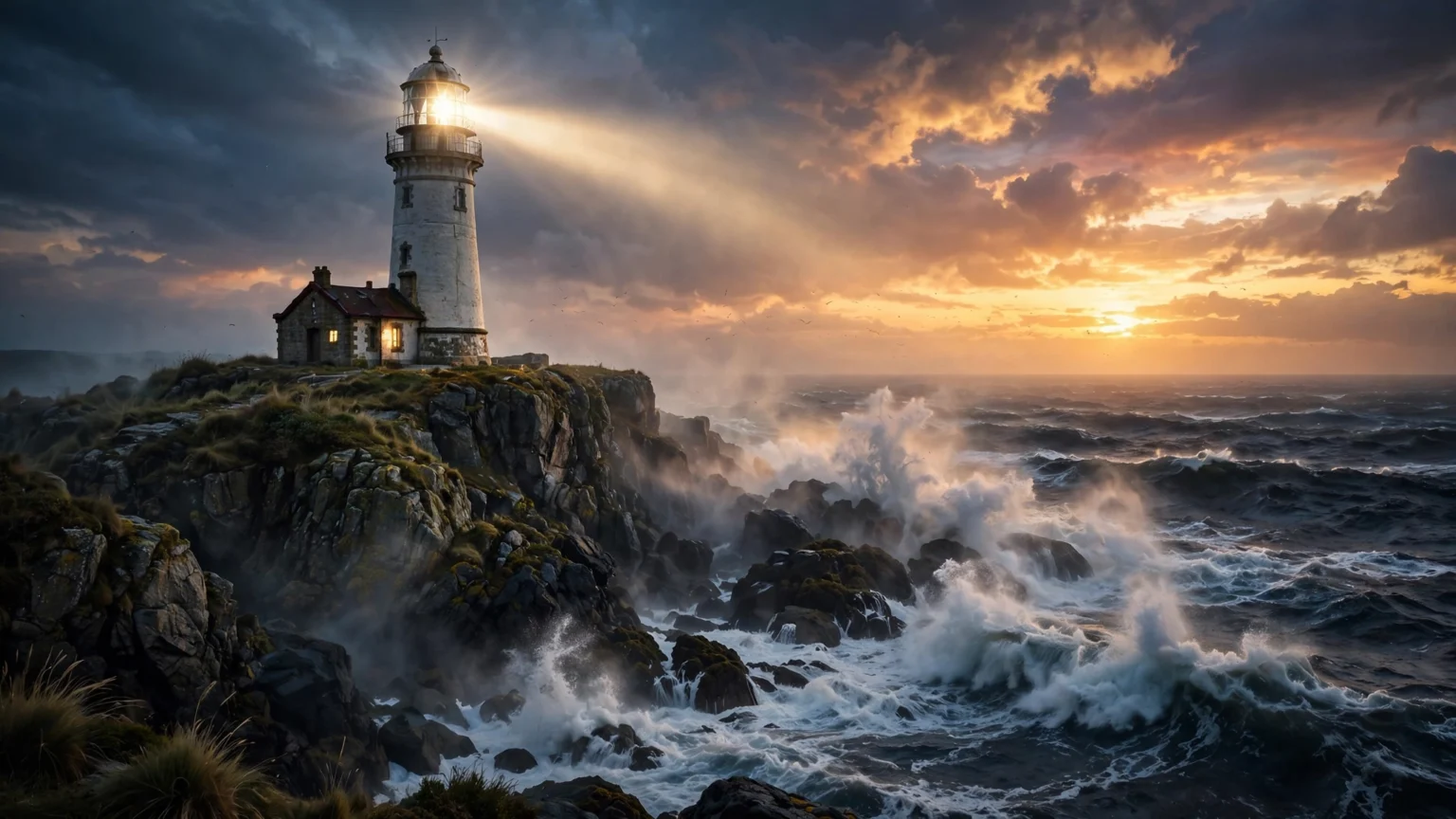

A lighthouse is far more than a tower beside the sea. It is a carefully positioned aid to navigation, built to mark coastlines, dangerous rocks, harbour entrances, reefs and safe passages. The International Organization for Marine Aids to Navigation defines a lighthouse as a substantial structure erected at a designated location to carry a signal light and assist marine navigation.
For thousands of years, these coastal landmarks have helped sailors understand where they are and what lies ahead. Their history reflects the growth of maritime trade, the development of civil engineering and the continuing search for brighter, more reliable light.
The lighthouse has changed dramatically over time. Open fires became oil lamps, oil lamps gave way to electric bulbs, and resident keepers were gradually replaced by automatic controls. Yet the basic purpose has remained remarkably consistent: to make danger visible before it is too late.
Early Beacons
Long before builders constructed recognizable lighthouse towers, coastal communities used fires as navigational signals. A fire placed on a cliff or hill could help sailors identify a harbour, settlement or hazardous stretch of coast after sunset.
These early beacons were simple, but they introduced the central principle behind every lighthouse that followed. A light became useful when it was placed at a known location and could be recognized from the water.
Natural elevations were especially valuable because the higher a fire stood above sea level, the farther its glow could usually be seen. However, an exposed fire was difficult to control. Rain could weaken it, wind could scatter it, and poor-quality fuel could produce more smoke than light.
As shipping expanded, temporary fires were no longer sufficient. Important ports needed permanent structures that could raise a signal above surrounding buildings and protect the flame from severe weather. This need gradually turned the coastal bonfire into an engineered maritime landmark.
The Pharos
The Lighthouse of Alexandria, commonly known as the Pharos, became the most celebrated lighthouse of the ancient world. It was constructed on the island of Pharos outside Alexandria’s harbour during the Ptolemaic period, probably between approximately 300 and 280 BCE.
Estimates of its exact appearance vary because the structure no longer survives intact. Historical and archaeological studies generally describe an enormous tiered tower rising more than 100 metres. It became one of the Seven Wonders of the Ancient World and demonstrated that a lighthouse could be both practical infrastructure and monumental architecture.
A fire at the top guided ships approaching Alexandria, one of the Mediterranean world’s most important commercial and cultural centres. The building also announced the power and wealth of the city. Sailors did not simply see a light; they saw a landmark representing the port they were about to enter.
The influence of the Pharos extended beyond its physical life. Its name became closely associated with lighthouses in several languages. The structure suffered repeated earthquake damage and eventually fell into ruin, but its reputation established an enduring model: a tall coastal tower carrying a visible signal above a major harbour.
Roman Strength
The Romans developed lighthouse construction across their trading and military networks. Their engineers understood that a permanent coastal signal required more than height. It needed foundations, durable masonry, interior access and enough space for fuel and workers.
The most important surviving example is the Tower of Hercules at A Coruña in northwestern Spain. The Romans built the original lighthouse, known as the Farum Brigantium, in the late first century CE. It has continued to serve as a maritime landmark and remains the only fully preserved Roman lighthouse still used for its original general purpose.
The tower stands on a rock approximately 57 metres above the sea and rises another 55 metres. Around 34 metres belong to the Roman masonry, while the upper sections and external facing reflect a major eighteenth-century restoration led by architect Eustaquio Giannini.
Its history reveals an important feature of lighthouse evolution: old structures were often adapted rather than abandoned. Builders could strengthen an ancient core, add a new lantern and install modern optical equipment without removing the landmark that generations of sailors already recognized.
Medieval Lights
After the decline of Roman authority in Western Europe, lighthouse construction became less coordinated. Some ancient towers disappeared, while others were reused, repaired or incorporated into defensive sites.
Monasteries, churches, fortified ports and local authorities sometimes maintained coastal lights. These signals varied greatly in quality. A flame might be displayed from a tower, a gatehouse or an elevated platform, but there was rarely a standardized network connecting one region to another.
Medieval navigation depended heavily on daylight landmarks, local pilots and accumulated knowledge of the coast. At night, even a modest light could be valuable, although it might not be powerful enough to warn ships far offshore.
The period should not be viewed as a complete break in lighthouse history. The basic knowledge survived: sailors needed recognizable marks, harbour approaches had to be identified, and dangerous coasts required warning signals. What was missing in many places was the organized administration and technology needed to maintain reliable lights on a large scale.
Maritime Expansion
European maritime trade expanded rapidly from the late medieval period into the early modern era. Larger ports, longer voyages and busier coastal routes increased pressure for dependable navigational infrastructure.
Organizations responsible for maritime safety began establishing and managing lights more systematically. In England, Trinity House was formally incorporated in 1514 and later became deeply involved in the provision of lighthouses and other aids to navigation. It established the Lowestoft Lighthouse in 1609.
Many early modern lighthouses still used coal or wood fires. These could be visible at a distance under suitable conditions, but they consumed large quantities of fuel and required constant attention.
Coal-fired lights also produced smoke, sparks and uneven illumination. Nevertheless, they represented an improvement over temporary coastal fires because they were maintained from permanent stations at published locations.
The development of lighthouse authorities was as important as the development of the towers themselves. A reliable light required funding, inspections, trained workers, fuel deliveries, maintenance schedules and accurate information for mariners. Lighthouse history therefore became a story of public administration as well as architecture.
Stronger Towers
As maritime traffic moved closer to dangerous offshore rocks, builders faced one of the greatest challenges in civil engineering: constructing a tower where waves struck with enormous force and work could be completed only during short periods of calm or low tide.
The Eddystone Rocks southwest of Plymouth became a testing ground for new ideas. Several lighthouses were built there, destroyed, replaced or redesigned. The first Eddystone rock lighthouse was completed in 1698 and was swept away during the great storm of 1703.
Engineer John Smeaton designed a much stronger replacement, completed in 1759. Inspired by the shape of an oak tree, he gave the tower a broad, curved base and narrowing upper section. He used dovetailed masonry blocks and hydraulic lime capable of setting in wet conditions.
Smeaton’s approach became highly influential. His interlocking stonework helped the tower behave as a unified mass rather than a pile of separate blocks. The design offered a practical model for later offshore lighthouses, including the Bell Rock Lighthouse in Scotland.
This period transformed the lighthouse into a symbol of professional engineering. The challenge was no longer merely to place a fire on a coast. Engineers had to study waves, rock foundations, construction materials, wind loads and the movement of heavy stone across open water.
Better Flames
Improvements inside the lantern were just as important as stronger towers. For centuries, the brightness of a lighthouse depended largely on the fuel being burned and the keeper’s ability to maintain the flame.
Wood and coal gradually gave way to candles and oil lamps. The arrival of the Argand lamp in the late eighteenth century marked a major advance. Its circular wick and improved airflow produced a brighter, steadier flame than many earlier lamps.
Reflectors were then used to collect light that would otherwise spread in every direction. Parabolic reflectors could redirect more of the lamp’s output toward the horizon. Trinity House records the appearance of an early catoptric reflector system in 1777 and the circular-wick Argand oil lamp in 1782.
These changes made lighthouse beams more useful, but reflectors had limitations. Metal surfaces could tarnish, and even well-maintained systems allowed considerable light to escape. Engineers still needed an optical device that could capture a greater proportion of the lamp’s output without becoming impossibly thick and heavy.
The Fresnel Lens
The decisive optical breakthrough came from French physicist and engineer Augustin-Jean Fresnel in the early 1820s. Instead of using one thick conventional lens, Fresnel divided the optical surface into concentric sections and prisms.
This stepped arrangement greatly reduced the amount of glass required. It could gather light from a central lamp and concentrate it into a powerful horizontal beam. Prisms positioned above and below the main lens also redirected rays that would otherwise have been lost.
The first major lighthouse installation of Fresnel’s system took place in France, and the technology soon spread internationally. The National Park Service describes the lens as a development that revolutionized lighthouse illumination by allowing light to travel much farther than it could through many conventional systems.
Fresnel lenses were produced in different “orders.” A first-order lens was enormous and intended for major coastal lights, while smaller orders were suitable for harbours, rivers and less prominent locations.
Many lenses resembled glass beehives, with carefully arranged prisms held in brass frames. They were not simply beautiful objects. Each component had to be manufactured, polished, positioned and maintained with great precision.
Some lenses remained fixed and projected light continuously. Others rotated around the lamp, producing flashes. Rotation allowed one station to display a particular pattern, helping mariners distinguish it from neighbouring lights.
A Language of Light
A lighthouse does not communicate through brightness alone. Its light characteristic—the timing, colour and pattern of its signal—gives it an identity.
One light may show a single white flash every few seconds. Another may display groups of two or three flashes, alternate colours or remain visible for longer intervals followed by darkness.
These patterns function like names written in light. Mariners can compare what they observe with charts and official lists of lights to identify the station and confirm their position.
The physical appearance of a tower also matters during daylight. Different shapes, building materials, painted bands and colour combinations make one lighthouse distinguishable from another. A striped tower may therefore be a navigational feature rather than a decorative choice.
Fog created another problem because even a powerful beam could disappear in poor visibility. Lighthouse stations consequently used bells, cannons, whistles, sirens, horns and compressed-air signals. These audible warnings became part of the wider navigational system surrounding the tower.
The Keepers
For most of lighthouse history, reliability depended on human labour. Lighthouse keepers cleaned lenses, trimmed wicks, carried fuel, wound rotation mechanisms, recorded weather conditions and watched for equipment failures.
The work demanded discipline. A neglected wick could smoke and reduce the brightness of a lens. Dirty glass could weaken a beam. A stopped rotation mechanism could display the wrong signal and confuse ships.
Official instructions often required continuous night watches, strict cleanliness and careful maintenance of the lantern and station. Trinity House’s 1839 instructions stated that a perpetual watch had to be maintained throughout the night, shared by principal and assistant keepers.
Keepers also repaired buildings, painted metalwork, maintained boats and responded to emergencies. At isolated stations, supplies might arrive only when weather permitted. Life could be physically demanding, repetitive and dangerous.
Families frequently participated in the work. Women often assisted appointed keepers and sometimes took full responsibility after the death or incapacity of a husband or father. Historical records show that some women served as official keepers for many years, making lighthouse history broader and more complex than the familiar image of a solitary man in a tower.
Electric Light
Electricity changed both the brightness of lighthouse signals and the daily operation of stations. Experimental electric lights appeared during the nineteenth century, although early systems could be expensive and difficult to maintain.
Dungeness became one of the first lighthouses illuminated by electric light in 1862. Experiments at South Foreland later contributed to the decision to electrify Lowestoft High Light in 1870.
Electric lamps eventually offered cleaner and more dependable illumination than many oil systems. They also reduced the work involved in carrying fuel, tending burners and cleaning combustion residue.
The change was gradual rather than immediate. Remote lighthouses could not always be connected easily to an electrical network. Some continued using kerosene, vapour burners or acetylene long after urban and harbour lights had been electrified.
Once dependable power, automatic lamp changers and control equipment became available, the permanent presence of a keeper was no longer essential at every station.
Automation
Automation reshaped lighthouse life during the twentieth century. Timers, sun valves, electrical controls and remote-monitoring equipment allowed lights to operate with less direct supervision.
The change happened at different speeds in different countries. Some stations were automated early, while remote rock towers remained staffed for decades. St Tudwal’s Lighthouse, for example, adopted an acetylene sun-valve system in 1922, while South Stack was not automated until 1984.
In the United States, electrification reduced the workload at many stations and contributed to the gradual removal of resident staff. The process also changed the physical character of light stations because keepers’ houses, workshops and fuel buildings were no longer always needed.
Trinity House completed its major lighthouse automation programme when keepers were withdrawn from North Foreland in 1998. By then, remote control centres could monitor the operation of lights and send maintenance teams when faults appeared.
Automation improved efficiency, but it ended a distinctive maritime occupation. The tower remained, yet the human community that had once maintained it around the clock largely disappeared.
Modern Beacons
Modern lighthouse equipment is usually smaller and more energy-efficient than the machinery it replaced. LED lanterns, solar panels, batteries, electronic controllers and remote fault reporting can keep a station operating with limited on-site attention.
Some modern lights continue to use historic Fresnel lenses, with compact electric or LED sources installed at their centre. Others use sealed lantern units designed specifically for low power consumption and long service life.
Solar energy is particularly valuable at isolated sites where connecting to an electrical grid would be difficult. Current heritage projects show that historic towers can remain active while using autonomous solar systems and LED-based lights.
Lighthouses now operate within a much larger navigational environment that includes buoys, radar beacons, satellite positioning, Automatic Identification System information and digital chart services. IALA’s S-201 specification, for example, supports standardized digital information about aids to navigation, including lights, buoys and beacons.
This does not make the lighthouse meaningless. A visible fixed landmark provides immediate geographic information without requiring a mariner to interpret a complex display. Modern navigation is strongest when different systems support one another.
Living Heritage
Many historic lighthouses have outlived their original equipment, but they remain valuable as working landmarks, museums, engineering monuments and records of coastal life.
Preserving them is difficult. Salt, wind, moisture and wave action attack masonry, metal, glass and timber. Empty buildings may deteriorate rapidly once resident keepers leave.
Successful preservation often depends on cooperation between navigation authorities, local governments, museums, charities and volunteer groups. In some cases, the navigational light remains under official control while the surrounding buildings are opened to visitors.
Historic lenses require especially careful treatment. Their glass prisms and metal frames are heavy, delicate and difficult to replace. When preserved in their original lantern rooms, they allow visitors to understand how optical engineering changed maritime safety.
IALA recognizes historic lighthouses not only for their age but also for their architecture, technical achievement, archaeological importance and cultural value. Its heritage programme emphasizes that lighthouse significance often extends well beyond the function of the light itself.
Why They Endure
The history of the lighthouse is a history of continuous adaptation. Ancient builders raised fires above harbours. Roman engineers built durable masonry towers. Early modern authorities organized networks of coastal lights. Civil engineers learned to anchor structures to wave-washed rocks, while optical specialists transformed small flames into powerful beams.
Electricity and automation removed much of the daily labour, but they did not erase the lighthouse’s importance. The structure still connects geography, technology and human experience in a form that can be understood at a glance.
A lighthouse marks a real place. It stands where land meets water and where safe passage may lie close to disaster. That physical presence explains why these buildings remain powerful symbols even in an age of satellites and electronic charts.
Their technology will continue to evolve, but the idea behind them is ancient and durable: a dependable light, placed where someone at sea needs to see it.
FAQs
What was the first lighthouse in history?
The earliest coastal signals were probably simple fires rather than purpose-built towers. The Lighthouse of Alexandria, constructed during the third century BCE, is the most famous ancient lighthouse and one of the earliest monumental examples known in detail.
How did old lighthouses produce light?
Early lighthouses burned wood or coal. Later stations used candles, whale oil, vegetable oil, kerosene, acetylene and other fuels before electric lamps became common.
Why was the Fresnel lens important?
The Fresnel lens used rings and prisms to collect and direct more light while requiring less glass than a thick conventional lens. It produced a stronger, more efficient beam and became one of the most important advances in lighthouse technology.
Do lighthouses still have keepers?
Most operational lighthouses are now automated and maintained by visiting technical teams. A small number may still have staff, guides, caretakers or heritage personnel, but traditional round-the-clock light keeping has largely disappeared.
Are lighthouses still useful when ships have GPS?
Yes. Lighthouses remain recognizable visual aids and fixed geographic references. They operate as part of a wider system that may include satellite navigation, buoys, radar equipment, digital charts and electronic maritime services.
Read more: International Travel Insurance: A Practical Guide for Safer Trips Abroad
